
- The study draws on the views of more than 1,400 workers, students, businesses and academic institutions across seven countries. It concludes that AI has become part of the workplace for day-to-day tasks, where the judgement of the person using it makes all the difference.
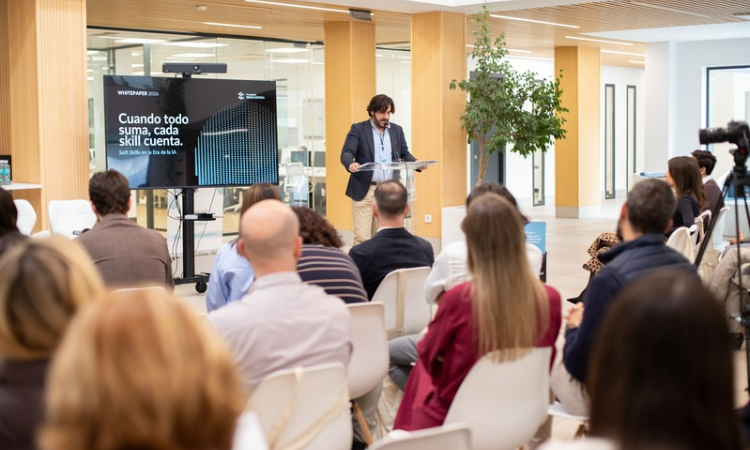
The EDUCA EDTECH Foundation presented the 2026 White Paper at its headquarters on Thursday, Soft Skills in the Age of AI, the second edition of its research project on employability. The report analyses which human skills become more valuable when artificial intelligence takes over routine tasks, and who is at risk of being left behind.
The study surveyed 1,490 people from Spain, Mexico, Colombia, Argentina, Chile, Peru and Ecuador using three parallel questionnaires: 767 workers and students, 492 companies and 231 academic institutions.
“For the Foundation, the white paper is our research project: a way of listening before acting,” explains Viridiana López, director of the EDUCA EDTECH Foundation. “Now that AI is taking on much of the routine work, what makes the difference is how we think, communicate and adapt. And the good news is that these skills can be learnt.”.
What is required vs what is taught
Workers, businesses and institutions all agree that soft skills will become more important than technical skills, with net scores of between 39 and 45 points. The problem is not the amount of training, but its focus. The leadership and the the ability to adapt to the current uncertainty These are the skills where there is the greatest gap between what employers are looking for and what educational institutions prioritise. In contrast, the communication and the analytical thinking are set higher than required.
Furthermore, only one in six companies provides ongoing, structured training in these skills.
According to Pablo Ybarra, Chief B2B Officer at EDUCA EDTECH Group, companies are looking for
“Precisely what AI does not do: the judgement to make decisions, the leadership to mobilise others, and the ability to adapt when plans change.”.

The blind spot in digital security
The report includes a Digital Vulnerability Index which puts a figure on a risk that is not disclosed. The 27 % for workers combines high vulnerability with few perceived barriers; this group is almost twice as large as those who are vulnerable and recognise it. Educational attainment carries more weight than age: high vulnerability ranges from 32 % amongst those with a university degree to 74.4 % amongst those who only completed secondary education. Nor are current measures sufficient: 61 % of companies are aware that initiatives to promote access to training, compared with 37 % for workers.
“Those most at risk of being left behind are, above all, people with lower levels of education and little digital experience, and they often do not realise this,” says Viridiana López.
It also produces the podcasts “Educa Tu Futuro” and ‘Generación EDTECH’, “which offer guidance, role models and relatable conversations to help you take that first step”.
Five perspectives on what AI cannot replace
Following the presentation of the data, a round-table discussion applied the study’s findings to the fields of business, technology and training. The participants were:
- Chema Robles, CEO of Montevive.AI
- Rafael Artacho, AI Product Strategy at Unit4
- Álvaro Serrano, Director of Inteligenia
- Patricia Ortiz, from the Academic and Student Success department at EDUCA EDTECH Group
- Pablo Ybarra, Chief B2B Officer at EDUCA EDTECH Group
The human judgement versus the machine was the common thread running through the debate. “AI must be governed by people. We must learn not to trust the answers provided by AI, and that is something you learn through experience,” argued Robles. Serrano put it in terms of a habit: “You have to ask follow-up questions: where does the information provided by AI come from?”.
Speaking from the classroom, Ortiz agreed with what the data from the white paper: “The skills most in demand in training are adaptability and critical thinking.”.
A project with continuity
The study builds on the 2025 edition, which gathered the views of 2,806 people. The presentation, which featured a round-table discussion with spokespersons from the group, brought together representatives from human resources, training and social organisations. The full report can be downloaded from the EDUCA EDTECH Foundation website.