
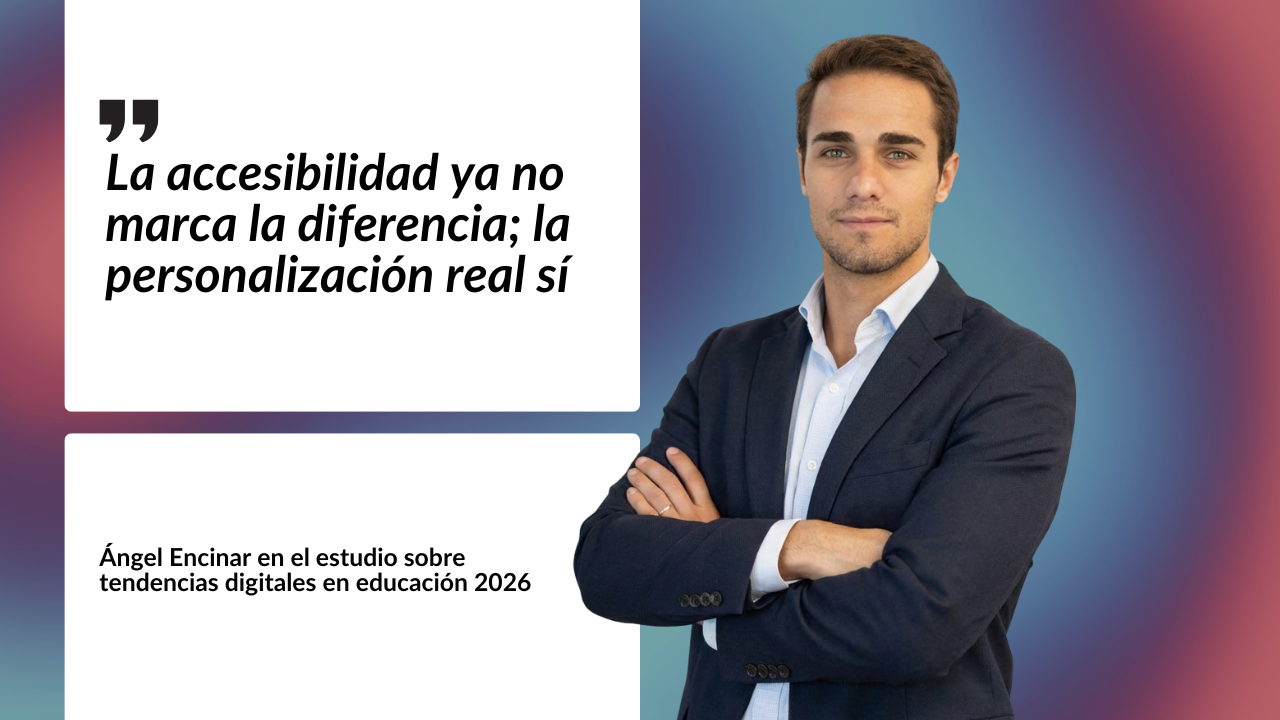
- Angel Encinar, Chief Operations Officer of EDUCA EDTECH Group, participates in the report «Digital Trends in Education 2026» by t2ó, where he analyses how artificial intelligence is redefining training strategies in the sector. According to Encinar, educational institutions are no longer competing to reach more students, but to accompany them in a way that is genuinely adapted to their individual needs..
E-learning is no longer measured solely by its ability to remove geographical barriers. By 2026, according to the study ‘Digital trends in education 2026‘ by t2ó, a company specialising in advertising, digital marketing and technology transformation, competitive differentiation lies in the personalisation of learning and the strategic use of proprietary data.
Ángel Encinar Luengo, Chief Operations Officer of EDUCA EDTECH Group, participates in this report by analysing three fundamental axes: the role of the artificial intelligence in the student experience, building competitive advantage based on the student's experience, building competitive advantages based on data first-hand experience and the risks of automation without editorial judgement.
Accessibility of training is no longer a competitive differential.
For years, online education platforms have focused their value proposition on flexible hours, the elimination of travel and geographical openness. Ángel Encinar states in the t2ó study that «accessibility no longer differentiates anyone».
The fundamental change, according to the manager, is to move from available training to truly adapted training. This transformation forces institutions to redefine what it means to accompany a person in their professional development beyond offering course catalogues.
EDUCA EDTECH Group, for example, has developed EDUCA LXP, The methodology integrates adaptive technology, learning platforms, artificial intelligence and human accompaniment with the aim of placing the student at the centre of the learning experience.
AI as a resolution tool, not a technological showcase
The t2ó report identifies the artificial intelligence as one of the main trends shaping the education industry in 2026. For Encinar, the value of this technology does not lie in its media presence, but in its ability to solve concrete problems for students. As the COO of EDUCA EDTECH Group points out in the interview.
«The student doesn't want philosophy: he wants the problem solved quickly and well».»
With this system, which manages tens of thousands of active students distributed across multiple educational brands, virtual assistants and automated systems make it possible to sustain the quality of the service. However, Encinar warns against the risk of automating without pedagogical context.
“The focus is not so much on how many touch points we automate, but that our quality of care is the highest, regardless of the technology we use.
This vision connects with the PHIA development, EDUCA EDTECH Group's digital mentor, designed to offer immediate support without eliminating pedagogical criteria or human proximity.
Own data vs. reliance on external aggregators
One of the central points of Encinar's participation in the study focuses on the strategic importance of first-hand data for the recruitment and retention of international students. He warns against the dependence on external platforms or aggregators:
«The problem is that you don't own that data: you rent it, and they rent it more and more expensively».»
EDUCA EDTECH Group is committed to building accumulated knowledge about the student: what motivates them, what holds them back, why they stay, why they drop out and what leads them to return to training. According to Encinar, the competitive advantage is not only in recruiting better, but in understanding the complete cycle from the first click to employment.
«When you're able to see that whole journey, you start to understand patterns that no external aggregator can give you.»says the COO
This knowledge enables more precise decisions to be made on product, price, training offer and support strategies.
The risk of losing authenticity in the age of auto-generated content
Generative artificial intelligence has accelerated the creation of educational, commercial and corporate content. Encinar identifies a growing risk in the t2ó study: that all educational institutions end up sounding the same.
«Generative AI allows content to be produced at a speed and scale that was unthinkable two years ago. And it is tempting. But there is a real risk: that all educational institutions will start to sound the same».»
For Encinar, the solution is not only technological, but editorial.
The education debate in 2026: integrating AI without losing pedagogical depth
The study «Digital Trends in Education 2026» by t2ó agrees with organisations such as the OECD and UNESCO that the mass adoption of generative artificial intelligence represents the real turning point for the education sector. According to UNESCO, 90% of university students use AI tools for school purposes and 45% of teachers implement it on a daily basis..
By 2026, the debate is no longer about whether artificial intelligence should be part of learning, but about how to integrate it without losing depth, judgement and humanity. Ángel Encinar's participation in this study reinforces the positioning of EDUCA EDTECH Group as a technological-educational actor committed to innovation with a pedagogical sense.